Tuesday, March 8, 2016

Public art at Gurgaon

The city of Gurgaon is located just outside the southern border of the national capital of Delhi. It has got rapidly urbanised in the last fifteen years or so, and today its skyline boasts some of India's most recognizable and contemporary high rise residential and commercial buildings.


Gurgaon has an ancient past, and has got its name from "Guru-gram", or literally the "village" of the master. The land was supposed to be owned by the royal families of Pandavas and Kauravas, and was given to Guru Dronacharya in appreciation of his teaching the young princes the art of warfare. 


Just ten years back, peacocks, hoopoe, kingfisher, the tailorbird, robin, sunbird, owls, sparrows and hawks would be seen in plenty on the city balconies, terraces and verandahs. Now with decline of perching places,  a growing population, decreasing green cover, more traffic and urban chaos, most of the birds have disappeared. Some hardy crows, mynahs and pigeons are holding out.

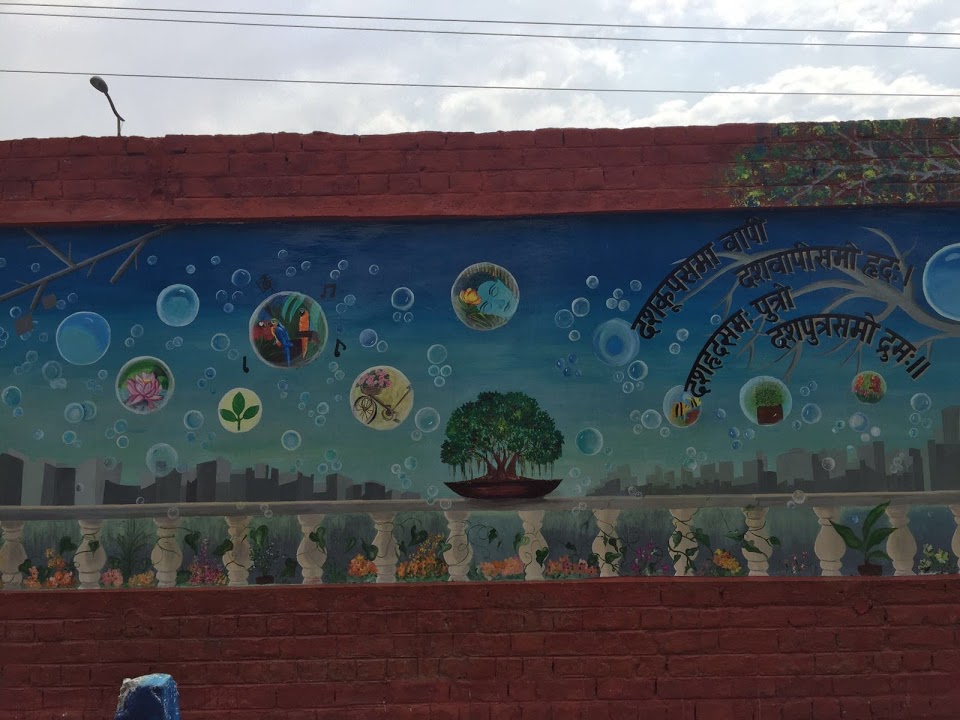
The initiative by the municipal corporation of Gurgaon (MCG) and a citizen's forum, Gurgaon Action Plan (GAP), was welcomed therefore by artists and laymen alike. The idea was to get groups of artists to work together and paint some wall spaces, on anything to do about the past and present of Gurgaon. 

The MCG cleaned up some wall spaces on one of the main roads of the city, M. G. Road. Teams of 5-6 artists worked on each of these walls, with school children, lay citizens and bystanders all chipping in. 


The end result was varied, colourful, and refreshing. The biggest takeaway was getting passers-by to get involved into art. People who had never stepped into a gallery, or never paused to think while rushing to their jobs about beautifying the city, stopped, appreciated and got involved. It was a truly moving experience, to hear from passers by, on how much they appreciated the volunteering artists, and how much they had enjoyed doing their bit!


Monday, February 22, 2016

A visual history of time

Cosmologists study the birth and evolution of the universe, and the ultimate fate of the universe. The questions and answers as varied and dynamic as those dealing with the creation of man:
Who am I? Where do I come from? Where am I going?


The artist in Kavita Jaiswal explores the process of creation without all the analytics: enjoying the flow, the colours and forms.

In this composition, the artist explores the space within the womb, where human life is created: exploring the various configurations, waves and harmonies created. So many complex interactions coming together and moving apart.

All the dynamics ultimately evolves towards a unique synthesis of dependent and interdependent processes and forms.

An intense exploration into these forms forces the artist to focus in some of the compositions, on the here and now, the present. In some others, there is an exploration of the dynamics over time. and in some, the two are juxtaposed.


 This composition, titled: "No beginning, no end" is one such. It captures one such moment in the evolution of the earth, as mountains, rivers, valleys, seas and plains form and re-form.

Indeed we could be exploring the birth of man, the earth or the universe. The churning, flowing, appearing and disappearing is all too similar.


All art, and all science, is finally, nothing but an exploration into time and space!

Tuesday, January 26, 2016

A kaleidoscope of paintings

Winter in Delhi normally gets less severe after the festival of "Makar Sankranti". This is the day when the Sun stops moving southwards at the Topic of Capricorn (this southward journey is called "Dakshinayana"), and starts its northwards journey (or "Uttarayana") towards the Tropic of Cancer.


The international art symposium planned at Karma Lakelands, Gurgaon, was obviously to take advantage of the sunny weather post Makar Sankranti, and have an open-air live painting event.

A visit to the venue was like a kaleidoscope of colours and styles of art.


There was a variety of styles on display. There were compositions with bright colours and bold strokes. And there were some that almost blended with the patterns of nature, and seemed to celebrate them.


Artists came from different countries. Each had their own unique thinking, and things to say. And I had a good time chatting up with them.

I do think we need to have more of these events. Just like music has an orchestra, we do need artists with different things to say, to do their bit independently, and share their thoughts and experiences with each other.


The art works are on display beyond the event, and visitors can interpret the art works afterwards in any which way they want.


The Delhi weather allows outdoor painting only for a few months each year. So it would be great to have more of such events.


Saturday, December 19, 2015

A picture worth a thousand words and a film

The district of Morigaon in Assam is known for the place of occult, Mayang, the Pobitora wild life sanctuary, and the ferocity of its floods.


Ritu Raj Konwar, the Guwahati based special news photographer, was covering the floods in 2014, and clicked this photograph for "The Hindu". It showed a little boy carrying his goats to safety in a raft made of banana trunks, using the thin branch of a tree for steering through the flood waters.


While the Morigaon region sees frequent downpours, the 2014 floods were specially severe, with more than 2,00,000 people landing in relief camps. Even the rhinos of Kaziranga National Park were affected and several got electrocuted, and as in the picture alongside, the dead rhino had to be dragged away with the help of elephants. Unfortunately, the remote areas of the north-eastern states of India, do not get sufficient national media attention.


However, the photograph of the little boy carrying his goats, caught the attention of well known Malayalam film maker, Jayaraj, known for his art house films, as well as mainstream ones. He was inspired to make a movie about a little boy, and his grandfather, called "Ottaal", which he based on the Russian story by Chekhov, "Vanka".


Ottaal went on to win the "Golden Gateway of India Award" at the Mumbai Film Festival, 2015.
And Jayaraj recently went on to do what he was planning ever since he first saw the photograph. He tracked down the little boy, Ashadul Islam at his village Kuchani in Morigaon,Assam.


Jayaraj has announced he is going to look after little Ashadul's upkeep, health and education. Ashadul's parents are daily-wage labourers in a brick factory, and this help will go a long way for the family.

Jayaraj's visit also helped draw some attention to the small village of Kuchani, and its desperately poor people. Jayaraj's charity foundation has said it would look after the health needs of the village.

http://www.thehindu.com/news/cities/kozhikode/jayarajs-ottal-changes-ashadul-islams-life/article8006027.ece

Thursday, December 17, 2015

Calvendo: A publishing house for artists

Calvendo was one of the first publishing platforms to enable creative artists to share their paintings, illustrations, digital art or photographs and self-publish them.

You can design calendars and poster books as print-on-order products.

I have to report a very happy experience doing my first calendar with them:

http://www.amazon.de/QUIETLY-FLOWS-RIVER-Calendar-Square/dp/1325133558

Calvendo uses state-of-the-art machinery to take out multi-coated high-quality prints on order.

I recommend them highly to all artists!


Friday, December 4, 2015

Lending a voice to deaf artists. By design.

Smriti Nagpal learnt to use sign language at home, while communicating with her two older siblings who were hearing impaired. She would often help out with her special ability, her friends and at the National Association of the Deaf, while pursuing her studies in business administration, and then later at work. Apart from her ability in sign language however, she combined rare sensitivity as well as business sense.


So when she met a hearing impaired artist, who was not able to reach out to the art community with his work, because of his disability, she decided to help. The result is an organization called "Atulyakala", quite simply: Art Unparalleled. It bridges this physical gap, and gets the artists to communicate with others in the field, and of course also with clients, customers, employers and suppliers.

Atulyakala sells from its website fine art prints like the one shown here, and also lifestyle products like mugs, bags and wallets. They work with artists and designers who can hear, and with customers of all types. They also hold workshops and events to create awareness about their work, and also because all of us who can hear need to be able to work with those who can't.


The amazing thing is Smriti, now 25, got all this going by age 23! She has got a lot of recognition now, specially with the under-30 young entrepreneurs' award as part of BBC's 100 inspirational women for 2015. She was chosen to interpret the Republic Day parade for the deaf community, on national television early this year.

Well, she has a lot to do. She does have her heart and head in the right place for it. For when asked by the BBC correspondent, on what advice she would give the viewers wanting to follow in her footsteps, she answered: "See few dreams, and follow them with all your heart, and the world will be right there, all yours!"

Sunday, November 15, 2015

A heart warming Children's Day Doodle

India celebrates 14th November as the birth anniversary of its first Prime Minister, Pandit Jawaharlal Nehru, and as an annual celebration of all the talent and potential in its children, the nation's future. This year's Google doodle was a great reminder of this talent, and our responsibility to nurture it.

The doodle was drawn by a nine year old boy, Karthik, a class III student. Karthik and his sister Ramya, a class IV student, had both taken part in a national level Google Doodle competition on the theme "If I could create something for India, it would be..". Karthik had envisioned "a machine to recycle all the plastic waste from our country and turn it into a material which helps the growth of mother nature..."


Both the children made it to the short list in their own age groups, and then into the final list of twelve doodles being considered.


Karthik's doodle was the final one chosen for the Google page. When the children got a phone call at home with the news, both of them got ready as fast as possible and ran to the school.

They didn't nave a computer at home, and the first thing they did was to put on the computer in the school lab, and check the Goggle search page. and there it was! It was true!


Karthik and his sister study at Sri Prakash Niketan, in Vizag, Andhra Pradesh. Their father drives one of the school buses in the same school. He was beaming with pride and happiness. He said he       couldn't help the children with their homework, but supported them as much as he could.


The school has now decided to reward the children's school by taking care of their educational expenses till Class X.

I had loved the Children's Day Doodle. It was even more heartwarming to read the story about the children behind the doodle.